

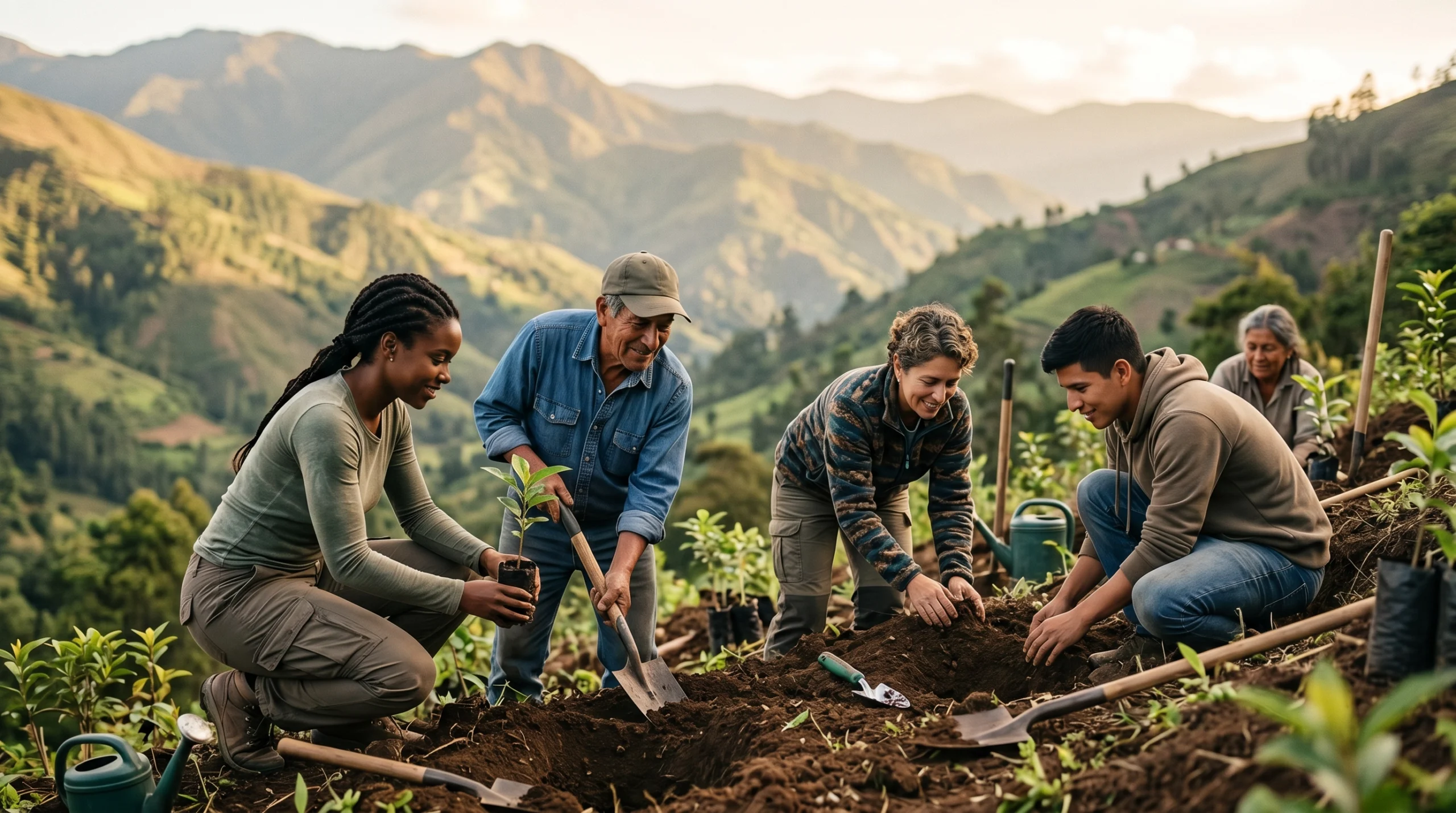
Why environmental and social issues go together
“Regenerative” is the buzzword of the moment. It appears in corporate reports, investment pitches, brand campaigns, and headlines about the future of agriculture, mining, and energy. And it almost always refers to something valuable: restoring soils, recovering ecosystems, capturing carbon, giving something back to the planet.
All of that is great news. And yet, there's another half of the equation that deserves equal attention but often gets overlooked: people.
At DelPlata Green, we've observed how the discourse surrounding regeneration is growing faster than its definition. And when a concept becomes fashionable before its meaning is clear, there's a risk of it becoming meaningless. That's why it's worth pausing to consider a simple question: what exactly are we regenerating?
From sustainability to regeneration
The difference between “sustainable” and “regenerative” is not cosmetic.
An approach sustainable It seeks to minimize damage: using less water, emitting less carbon, generating less waste. This is the logic of reducing the negative footprint. That's good, but its limit is zero: not to make things worse.
An approach regenerative It aims higher: to leave the system better than it was found. Not just to avoid harming, but to restore, return capacity, and generate positive net value. The term comes from regenerative agriculture—soils that regain fertility instead of being depleted—and is rapidly spreading to other industries.
So far, it all sounds like ecosystems. But here's the point that's being overlooked: A system is not just the ecosystem. It includes the community that inhabits it.
The social dimension is part of the system.
A project can restore a forest, recover a watershed, and capture tons of carbon, and still leave the local people in the same or worse off than before. If that happens, there was no regeneration: there was simply a greener form of extraction.
True regeneration also involves the social fabric: decent employment, local roots, community participation in decision-making, redistribution of the value generated, and strengthening of capacities that remain in the territory after the project ends. The "S" in ESG—the social dimension, the most difficult to measure and the easiest to disguise—is not a complement to environmental regeneration. It is an integral part of it.
This is where the world of social enterprises They have much to teach. These are organizations that are born with impact at the heart of their model, not as an afterthought. And within that universe, there is a category that functions as a natural bridge between both dimensions: the regenerative green businesses, Companies that offer solutions to climate change and restore ecosystems while They put people at the center. That intersection—the environmental and the social operating together—is what shapes a complete regeneration.
The risk of regenerative greenwashing
When a word promises so much, it becomes tempting as a label. And just as “greenwashing” turned “sustainable” into an adjective that sometimes means nothing, today we run the risk of a regenerative greenwashing: projects that claim to be regenerative because they plant trees or offset emissions, while ignoring—or even worsening—the social dimension.
The clearest example is the project that restores a landscape and, in the same breath, displaces the communities that depended on it. Environmentally sound on paper; socially exploitative in practice. That's not regeneration: it's a contradiction with good marketing.
The underlying problem is that “regenerative”, said without evidence, is a statement of intent, not a verified fact. And the distance between the two is precisely where credibility is at stake.
How it is measured: from intention to standard
Here we arrive at what, for us, is the heart of the matter.
The difference between say that something is regenerative and prove it It's the same difference that separates an intention from a standard. And that difference is called data.
A regeneration that can be legitimately claimed needs verifiable metrics in both dimensions:
- In environmental terms: clear baselines, indicators of soil, water and biodiversity restoration, real emissions balance, and verification by independent third parties.
- In social terms: indicators of local employment, value distribution, community participation in decision-making, and capabilities that effectively remain in the territory.
Without these measurements, “regenerative” is just a story. With them, it becomes a standard that can be audited, compared, and—above all—replicated. And replicability is what transforms a good, isolated example into a new way of doing things.
At DelPlata Green, we believe that sustainability—and even more so, regeneration—isn't decided at the end, like a cosmetic touch-up on an existing model. It's designed from the outset and demonstrated with evidence. Measuring, reporting, verifying: not as bureaucracy, but as the only way for big words to truly mean something.
Because regeneration isn't just about planting trees. It's about asking, with data in hand, whether the entire system—the soil and the people—is better off than when we found it.
At DelPlata Green we help companies in Latin America measure their footprint, Generate auditable ESG reports and manage carbon credits. Does your company already have its sustainability roadmap?