

By Silvina Dalton, for DelPlata Green
What is regenerative mining?
Regenerative mining is an emerging concept that goes beyond sustainable or responsible mining. While sustainable mining seeks to reduce environmental and social damage, regenerative mining aspires to something more ambitious: to give back more than it takes. It aims not only to minimize negative impacts but also to generate net positive impacts on ecosystems, communities, and the climate.
The concept borrows the language of regenerative agriculture—which seeks to restore soil health rather than simply avoid degrading it—and applies it to the extractive world. It is, in essence, the leap from “doing less harm” to “leaving the place better than you found it.”.
The only concrete case: Los Azules Project, San Juan, Argentina
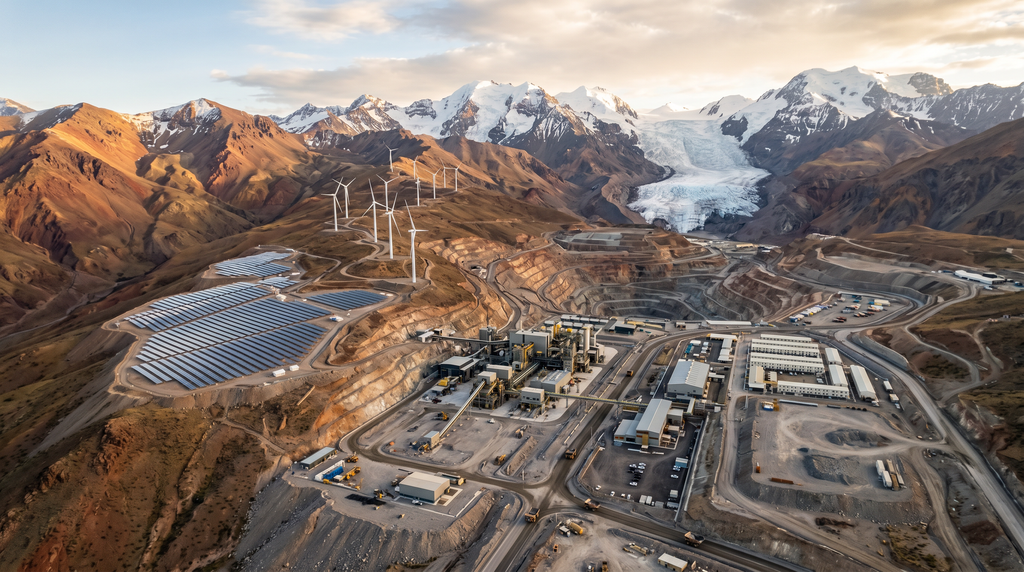
Today, there is no regenerative mine in operation anywhere in the world. There is only one under construction that aims to be one: Los Azules, McEwen Copper's copper project in the province of San Juan, Argentina, backed by Rio Tinto (Nuton), Stellantis, and the IFC (World Bank).
Project leaders announced their goal of creating “Argentina’s first regenerative copper mine — a model of responsible and innovative mining,” according to Michael Meding, VP and General Manager of Los Azules.
What does “regenerative” mean in Los Azules in concrete terms?
The project's 2025 Feasibility Study sets very specific goals compared to the industry average:
- 73% less carbon intensity (Scopes 1 and 2)
- 74% uses less water than conventional grinding
- 48% less electricity demand
- Without a tailings dam
- 100% renewable energy (agreement with YPF Luz)
- Carbon neutrality by 2038
The project camp — designed for 2,000 workers — is intended to be net zero energy, powered by on-site solar and wind energy, while closed-loop water systems, constructed wetlands and aquaponics ensure a net positive use of water.
The project also seeks to have long-term net positive impacts on the greater Andean ecosystem, local flora and fauna, the lives of miners and citizens of nearby communities, contributing positively to the local and national economy of Argentina.
Why is this relevant for Argentina and Latin America?
Los Azules is not just a mining project—it's a full-scale experiment. If it delivers on its promises, it will become the first global case study of regenerative mining in operation, and a benchmark for other world-class projects that Argentina has planned simultaneously.
The question the entire sector is asking itself — and which Los Azules will answer between 2030 and 2038 — is: can an extractive industry truly be regenerative, or is that an oxymoron?
The challenge: measure, report, and demonstrate
The concept of regenerative mining is powerful. But without a rigorous measurement framework, it risks becoming high-end greenwashing.
For regenerative mining to be credible and verifiable, it needs exactly the same things as any demonstrable sustainability strategy:
✔ Scope 1, 2 and 3 carbon footprint measurement with auditable data
✔ Verifiable indicators of positive net water impact
✔ ESG reports aligned with GRI 14 (the mining industry standard)
✔ Traceability of social and ecosystem impacts
✔ Independent third-party verification
Without those elements, “regenerative” is just a statement of intent — not a demonstrable reality.
Conclusion
Regenerative mining is the next frontier of extractive sustainability. Argentina has a unique opportunity to be at the heart of this debate—with Los Azules as a pioneering case and a mining sector that, for the first time in decades, is simultaneously building world-class projects.
The question isn't whether mining can be regenerative. The question is who will be able to prove it—with data, standards, and auditable evidence.
At DelPlata Green We accompany mining companies on that path — from the footprint measurement up to the generation of ESG reports aligned with GRI 14 and ISO 14001, with the technology of Zero Carbon One, the AI & blockchain platform that turns environmental data into auditable evidence.
Demonstrable sustainability is not a cost. It's the difference between declaring and demonstrating.
🌐 delplatagreen.com
Sources
- McEwen Copper / McEwen Mining — Los Azules Feasibility Study (October 2025). globenewswire.com
- McEwen Mining — Los Azules Project Page. mcewenmining.com/operations/los-azules
- McLennan Design / Perkins&Will — Los Azules: A Mine Camp of the Future. perkinswill.com
- Mining.com — McEwen's Los Azules copper project gets key environmental approval (December 2024)
- Mining Weekly — Los Azules feasibility study a blueprint for future copper mining (October 2025)
- Mining Panorama — Los Azules Feasibility Study Confirms Economically Robust Copper Project (October 2025)