

During Engineering Week dedicated to Argentine mining, we attended different panels that allowed us to analyze firsthand the growth that the sector is experiencing, driven, among other factors, by the implementation of the Incentive Regime for Large Investments —RIGI—.
Among the topics discussed, one of the most relevant was the development of local suppliers and their ability to compete for the provision of services related to new mining projects.
It is not just about supporting the growth of the sector, but about building productive capacities that allow a greater proportion of the value generated to remain in the provinces and communities where the projects are developed.
Empowering to compete
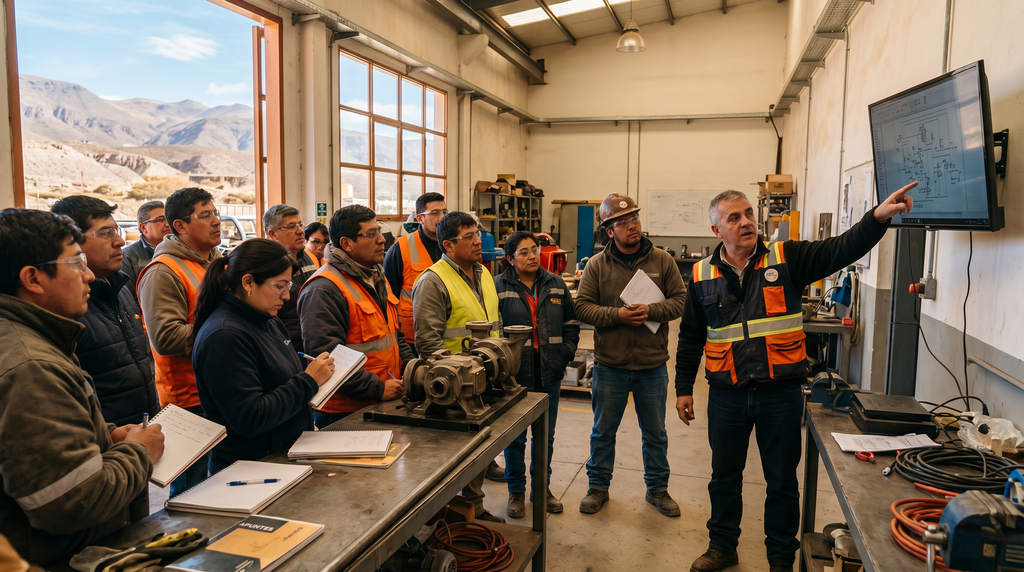
One of the outstanding cases was that of Catamarca, where training programs are being promoted for local suppliers, including for companies that participated in tenders and were not selected.
The goal is to help them identify gaps, improve their processes, and prepare to compete in future calls for proposals.
This approach is based on a fundamental premise: the ability to integrate into the mining supply chain is not built overnight. It requires training, investment, quality standards, technical knowledge, and operational experience.
The lessons of Vaca Muerta
The development of Vaca Muerta demonstrated that there is a learning curve for regional suppliers and that it is worth going through it.
As local companies gain experience, incorporate technology, and improve their standards, they can take on more complex contracts and compete on better terms with national and international suppliers.
The Neuquén experience also demonstrated the value of shared infrastructure. As noted during the panels, coordination between different operators enabled cost reductions of approximately 30%.
These precedents can provide relevant lessons for provinces that are currently preparing to receive large-scale mining investments.
A long-term economic strategy
The development of local suppliers should not be understood solely as a social policy or a community relations tool.
It also constitutes an economic strategy.
Provinces that plan today for the training of local businesses, professionals, and workers will be better positioned to capture a greater share of the value generated by mining activity in the coming years.
This involves anticipating future demand, identifying the goods and services that projects will require, and preparing regional actors to respond with adequate levels of quality, safety, traceability, and compliance.
Local development is also part of the ESG report
The participation of regional suppliers also occupies a relevant place within environmental, social and governance reports.
The composition of the supply chain, the development of productive capacities, the generation of indirect employment and the economic impact on communities are indicators that are being observed with increasing attention by international investors and other stakeholders.
Measuring these results allows us to assess how much value a project generates beyond its direct operation and to demonstrate how it contributes to regional economic development.
Among the indicators that can be reported are:
- The proportion of purchases made from local suppliers.
- The number of regional companies incorporated into the supply chain.
- Investments allocated to training and development of suppliers.
- The generation of direct and indirect employment.
- The territorial distribution of the economic impact.
- The evolution of local technical and productive capabilities.
Measuring the impact on the value chain
At DelPlata Green we help mining companies to measure, manage and report its impact on the local value chain.
Through Zero Carbon One's technology, organizations can centralize information, build ESG indicators, and consistently communicate their contribution to supplier development, regional capabilities, and communities.
The growth of Argentine mining represents an investment opportunity, but also an opportunity to build stronger, more competitive value chains that are linked to the territory.
The difference will be in which provinces and organizations start preparing now.