

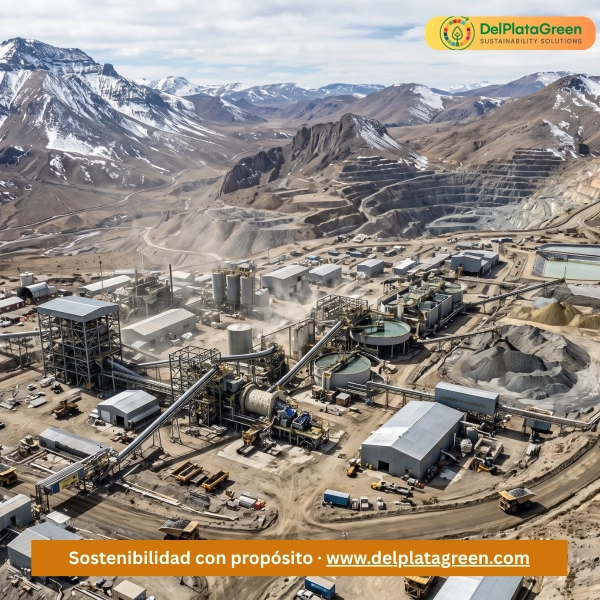
And why understanding the process is the first step towards demonstrable sustainability.
By Silvina Dalton, for DelPlata Green.
A journey in simple language, based on a real and public case: Cerro Negro Mine, Santa Cruz, Argentina.
When we talk about responsible mining, it's best to start with the basics: what exactly does a mine do? Behind every gram of gold lies a lengthy industrial process, and understanding it is key to knowing where the environmental impacts lie and how they are managed. In this article, we explore that journey—from rock to ingot—using a real-world case study whose Environmental Impact Assessment is publicly available: the Cerro Negro Mine in the province of Santa Cruz.
The case: Cerro Negro Mine
Cerro Negro is a gold and silver mining operation located in the Lago Buenos Aires department of Santa Cruz province. It is an underground mine whose Environmental Impact Assessment—the technical study the company submits to the province to obtain authorization—is publicly available. This makes it an excellent example to demonstrate, transparently, how rock is transformed into metal and what is done with the waste generated along the way.
The process, step by step
The basic idea is simple: rock contains minuscule amounts of gold and silver—just a few grams per ton—so the entire process aims to separate and concentrate this metal from the enormous volume of rock that surrounds it. The following diagram summarizes the complete process.
Comminution. It involves breaking the rock into smaller and smaller pieces: first crushing (large chunks) and then grinding until it becomes a fine powder, almost like sand. This is done because the gold is trapped inside the rock; it must be pulverized to release the metal particles.
Gravitational concentration. Gold is much heavier than ordinary rock. Taking advantage of this density difference, the material is passed through water in equipment where the heavier material (the gold) sinks and separates, while the lighter material is carried away. It's the industrial version of classic "gold panning," and it recovers the coarsest gold particles right away.
Leaching. To recover gold and silver that are too fine to separate by weight, the ground material is moistened with a chemical solution that dissolves the metal—in gold mining, this is usually a highly dilute and strictly controlled cyanide solution. The metal dissolves in the liquid, much like sugar in water. Due to its environmental sensitivity, this stage is heavily regulated and monitored.
Countercurrent decantation. Now there is a mixture of valuable liquid (with the dissolved metal) and valueless solid sludge. This stage washes and separates them in several successive steps: the rich liquid flows in one direction and the wash water in the opposite direction—hence the name—so as not to lose any metal. The clean solution with the metal comes out on one side; the waste solids on the other.
Merrill Crowe process. The metal still needs to be removed from the liquid and solidified. Zinc powder is added, which, through a chemical reaction, forces the gold and silver out of solution and causes them to precipitate as a solid. It's like making dissolved sugar crystallize again.
Doré ingot. This precipitate is melted and molded into bars. “Doré” is gold and silver together, still impure; it then goes to an external refinery that separates and purifies it. It is the final product that comes out of the mine.
What happens to the leftovers? Tailings
Not everything that enters the plant leaves as metal: the vast majority is crushed rock, now worthless, mixed with water. This waste is called tailings, and its management is one of the most sensitive environmental aspects of any mine.
Tailings dam. It is the large tailings dam where the tailings are deposited. It must remain stable and contained over time; therefore, its design, monitoring, and closure plan are central to the Environmental Impact Assessment.
Trench system. These are ditches around the dam that collect seepage—water that might run off—before it reaches the environment, for recirculation or treatment. It's a concrete and verifiable control measure, not just a statement of good intentions.
From process to evidence: demonstrable sustainability
Understanding the process reveals something important: each stage has an associated environmental impact—water consumption, energy, emissions, tailings generation—and, for each one, a management measure. The true leap in maturity is not having an environmental policy, but being able to demonstrate it with usable, traceable, and auditable evidence.
This is increasingly crucial for accessing markets and financing. Frameworks like the European CSRD and mechanisms like the CBAM—which incorporates carbon into market access starting in 2026—no longer settle for certifications: they demand traceability, verifiable methodology, and data. The strategic question in Latin America is no longer whether this will happen, but who will be prepared.
This is precisely the space where we work at DelPlata Green. As the exclusive representatives of Zero Carbon One in Latin America—an artificial intelligence, blockchain, and automation platform—we help companies to:
- Measure your carbon footprint in Scopes 1, 2 and 3 with verifiable data.
- Generate auditable evidence, with a clear method, data owner, and repository.
- Produce reports aligned with GRI, SBTi, TCFD and CSRD, ready for external verification.
A mine—like any business—stops merely “claiming” to be environmentally responsible when it begins to measure, manage, and demonstrate its environmental impact. This is the path from declarative to demonstrable sustainability, and it's the one we travel together with our clients.
Want to know how to measure and demonstrate the sustainability of your operation? Write to us at info@delplatagreen.com and let's talk about your environmental strategy.declarative to demonstrable, and it is the one we travel together with our clients.
Sources
- Environmental Impact Report – Cerro Negro Mine (5th Update), Executive Summary. State Secretariat of Mining, Province of Santa Cruz.
- National Law No. 24,585 — Environmental protection for mining activity, incorporated into the Mining Code of the Argentine Nation.
- Corporate Sustainability Reporting Directive (CSRD) and Carbon Border Adjustment Mechanism (CBAM) — European Union regulations.
- The process diagram (Figure 1) is self-made based on the description of the production flow contained in the Environmental Impact Report of Mina Cerro Negro.