

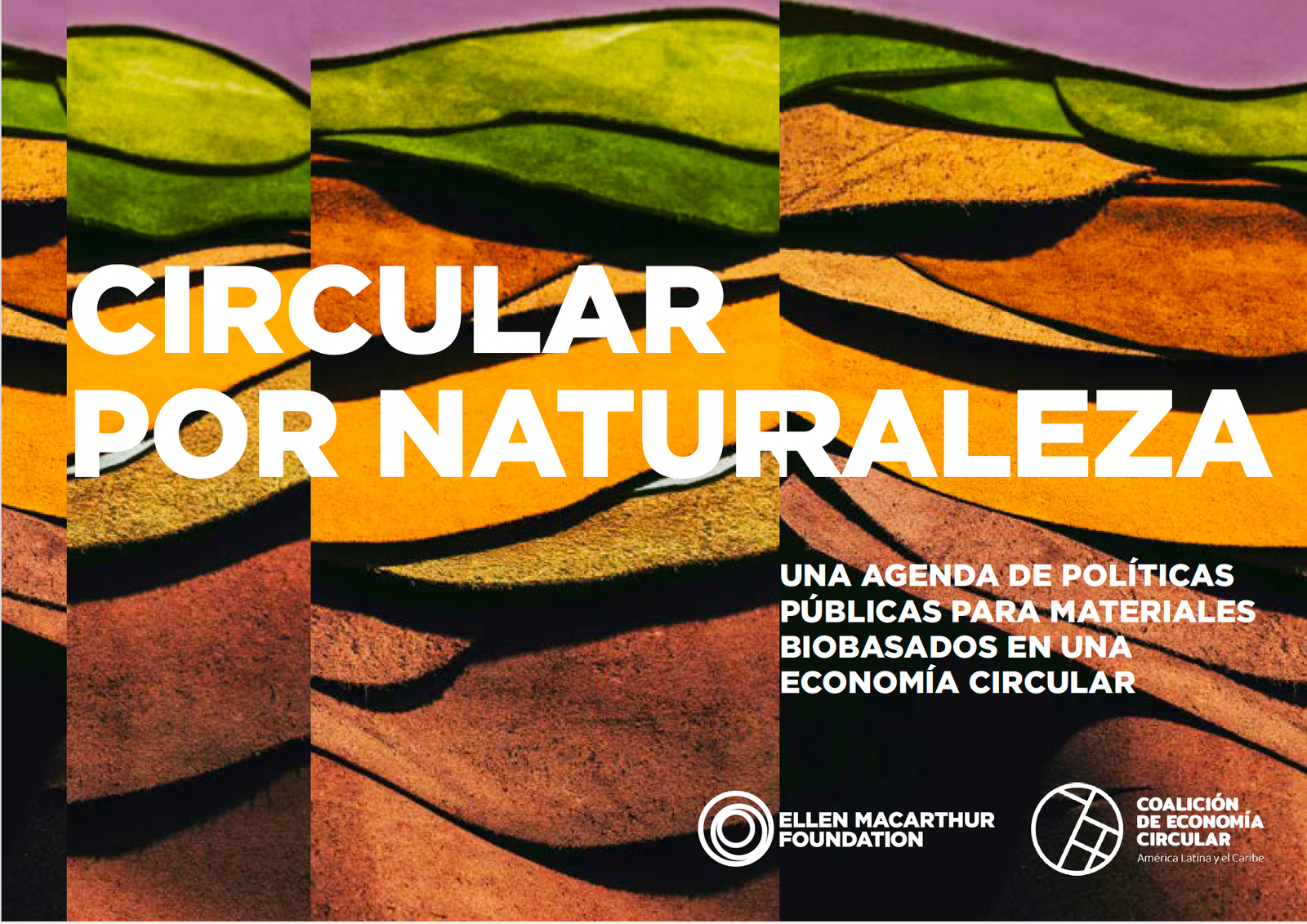
This week we read the report “Circular by Nature: A Policy Agenda for Biomaterials in a Circular Economy”, developed by the Ellen MacArthur Foundation along with the Circular Economy Coalition for Latin America and the Caribbean.
The document focuses on a key issue for the future of the circular economy: bio-based materials.
The circular economy must also look at biomaterials
The circular economy has made great strides in relation to finite materials, such as metals, plastics, and minerals. However, it has overlooked something fundamental: bio-based materials.
Cotton, wood, natural fibers, rubber and biochemicals form part of the foundation of huge industries such as fashion, packaging, furniture and construction.
The report, developed from the analysis of 13 national circular economy strategies and 18 bioeconomy policy frameworks, identifies a structural problem: both agendas usually run in parallel, but almost never intersect.
Circular policies treat bio-based resources primarily as a substitute for fossil fuels. Bioeconomy policies treat them as a commodity to be extracted and burned.
The result is that first use is rewarded, but not repair, reuse, or recycling. The linear system is optimized instead of redesigned.
A circular agenda for bio-based materials
The report's proposal is clear: bio-based materials should be obtained regeneratively, designed without substances of concern, intended to be durable, reusable in successive applications, and recoverable at the end of their useful life.
This recovery can occur through recycling, composting or biodigestion, within fair and inclusive value chains.
This approach allows us to think of biomaterials not only as an alternative to fossil materials, but as part of a more efficient, regenerative, and circular production system.
The numbers that shock
The report highlights some data that show the scale of the opportunity:
- More than 100 countries already have circular economy roadmaps, 34% more than in 2024.
- A positive transition for nature would represent $10 trillion annually in global opportunities by 2030.
- Bio-based products could prevent up to 2.5 billion tons of CO₂ per year in Europe.
- Argentina is part of the steering committee of the Circular Economy Coalition for Latin America and the Caribbean.
Real-life cases and regional opportunity
The report also presents real-world examples of companies that are already applying these principles, including Gucci, Klabin, Lojas Renner, MYNUSCo, Crystal, and the Uruguayan company TraceSurfer.
The central message is clear: the circularity of bio-based materials is not just an environmental opportunity. It is a concrete economic opportunity for producing countries in Latin America.
For the region, this opens up a strategic agenda. Latin America has natural resources, productive capacity, and value chains linked to bio-based materials. Integrating criteria of circularity, traceability, and environmental impact can strengthen its position in international markets.
Measure the impact across the entire value chain
To move forward in this direction, companies need to know more precisely the environmental impact of their materials, processes, and supply chains.
Measuring the footprint in the materials chain allows for identifying opportunities for improvement, reducing emissions, responding to new market demands, and building stronger environmental reports.
At DelPlata Green, we help Latin American companies measure and report their environmental impact across the entire value chain, using ZeroCarbonOne technology.
If your company needs to measure its environmental footprint, organize sustainability data, or move towards more comprehensive ESG reports, Contact us to learn about our solutions.